I had a pleasure to give a series of invited talks about pattern formation and processing of biological information during development at the Workshop on Flags, Landscapes, Signaling: From gene regulatory dynamics to tissue patterning & morphogenesis, IMSc Chennai India, May 6-17, https://www.imsc.res.in/~sitabhra/meetings/wfls24/. The series included introduction, research and chalk-talk. The workshop was aimed for PhD students with physics and biology background. Lectures were followed up by informal discussions with many insightful comments.
Category Archives: Uncategorized
Mateusz Sikora seminar!
On Monday Matt gave an invited talk on integrative modeling of glycoproteins on our weekly seminar of Enigmas of Chance. Matt is the head of newly established Dioscuri Centre for Modelling of Posttranslational Modifications, https://mcb.uj.edu.pl/en_GB/sikora-lab, at Małopolska Centre of Biotechnology of Jagiellonian University. The talked was followed by insightful discussion on applications of modeling to biological data.
PhD scholarship available!
We have opening for scholarship for one PhD student. The project goal is to understand to what extent growth, cellular dynamics, biomechanical feedbacks and global mechanical constraints limit patterning precision in the growing tissue. Details can be found at: https://zagorskigroup.com/open-positions/. If you are interested please contact me in advance. We wait for your applications till 1 October, but you already need to go through PhD recruitment at Doctoral School that takes place in June!
Talk at ALGORITMY 2024
On Tue I had pleasure to give talk about formation of gene expression patterns in developing spinal cord at ALGORITMY 2024 conference in Slovakia (https://www.math.sk/alg2024/). The talk was part of minisymposium on Computational methods and algorithms for biomedical applications organized by Elfriede Friedmann (University of Kassel) and Jurjen Duintjer Tebbens (Charles University). It was great opportunity for networking!
Floor plate formation on bioRxiv!
Our latest work on the formation of Shh morphogen source (floor plate) in the growing spinal cord is now available at: https://www.biorxiv.org/content/10.1101/2024.03.01.582751v1. By supporting computational results with experiments @Kicheva Lab we showed that the floor plate is formed in two distinct phases: rapid formation through gene regulatory interactions, followed by passive expansion by tissue growth. This result might be of general relevance for pattern formation in growing organs.
Commentary in Nature Communications!
Last week our commentary on assessing the precision of patterning in spinal cord appeared in Nature Communications. The text is open access: https://www.nature.com/articles/s41467-024-45148-8
Neuronus 2024 is coming!
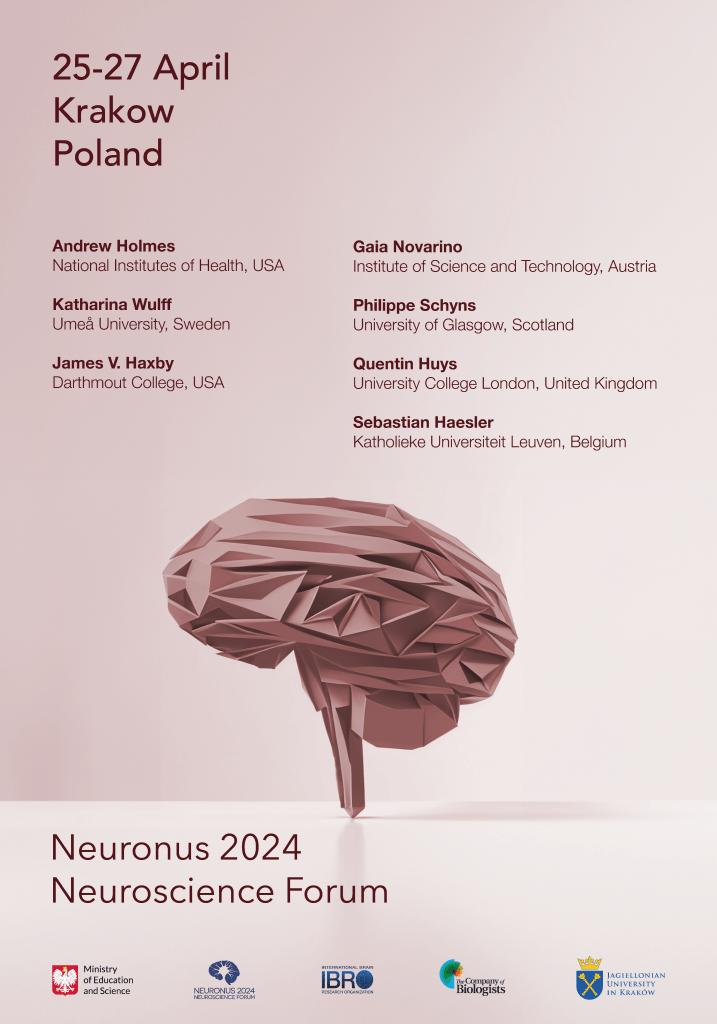
Joanna Doliwa and Maciej Kania are co-organising Neuronus conference this year. The conference will be held at the Auditorium Maximum of Jagiellonian University Krakow, Poland from 25-27 April, 2024. The program includes four sessions dedicated to biological, cognitive, computational, and medical neuroscience. Neuronus Neuroscience Forum is the biggest international neuroscience event in Poland and presents a wonderful opportunity to learn about the latest findings, share your work, and network. For more details on the registration process, invited speakers, workshops, and previous editions please visit https://neuronusforum.pl/.
Postdoc position in SONATA BIS!
There is another opportunity to join our team as postdoc. Details can be found at: https://zagorskigroup.com/open-positions/. I encourage to contact me in advance. We wait for your applications till 14 February 2024!
Great talks in Frankfurt!
Last week we participated in conference “Condensed Complexity” – The Essence of Information Processing and Cognition?, https://indico.cern.ch/event/1311584/overview. The conference program included three sessions on processing information by biological systems and was great opportunity for networking.
Registration for DBS2023 is now open!
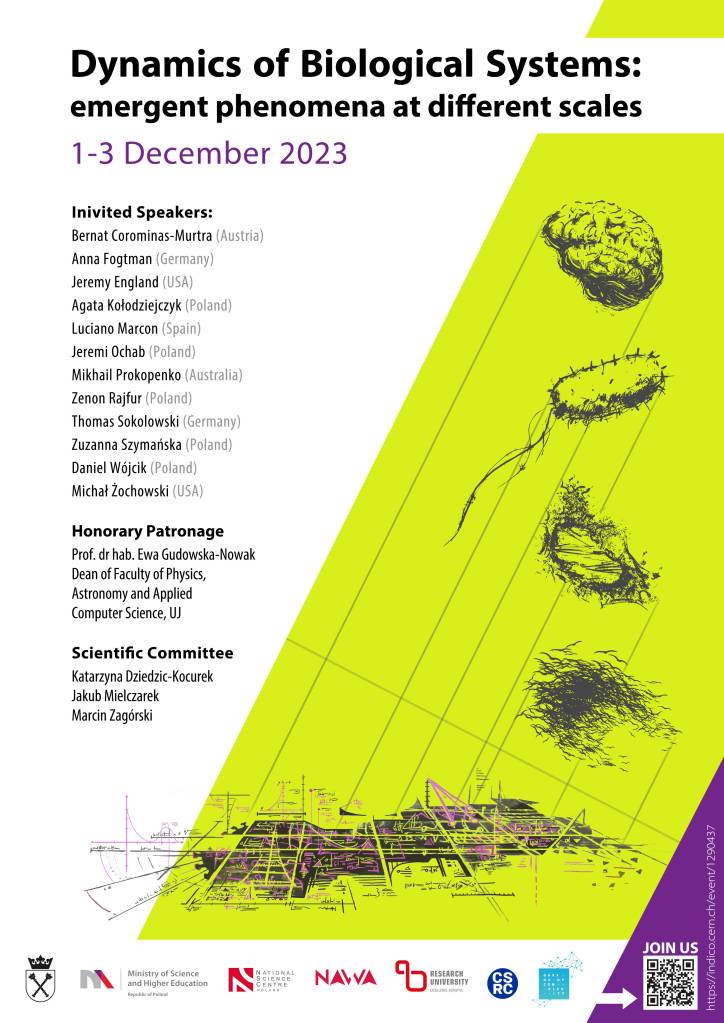
We organize conference ‘Dynamics of biological systems: emergent phenomena at different scales’ on 1-3 December. We have excellent line-up of speakers and expect many great contributions from participants! The conference is stationary in Krakow with possibility to attend on-line. Register now at: https://indico.cern.ch/event/1290437/